
Material comparison
Metal-Free Crowns vs PFM Crowns: A Practical Comparison
Metal-free and PFM crowns differ in appearance, preparation and long-term behaviour. This comparison sets out the trade-offs case by case.
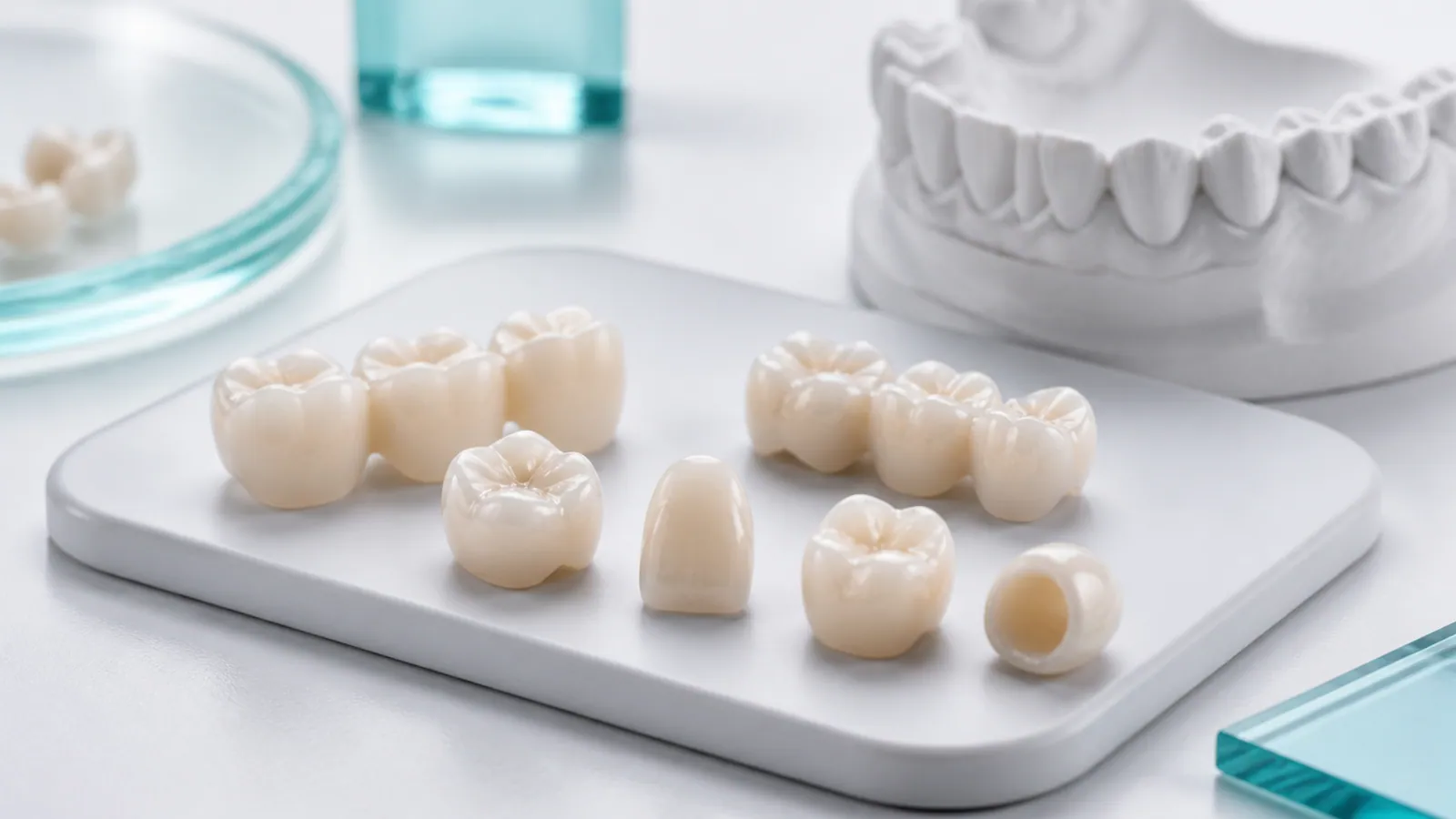
The choice between metal-free crowns and PFM crowns (porcelain-fused-to-metal) is mostly a trade between appearance and a proven, conservative preparation. Metal-free options such as zirconia and lithium disilicate pass light like natural teeth, while PFM carries a metal substructure that blocks light but has decades of predictable service behind it. Neither is correct for every case, so the decision should follow tooth position, opposing dentition and how much reduction the preparation can give. A clear specification keeps the lab from guessing which way you intended to go.
This comparison covers esthetics, strength, preparation, tissue response and repair, then how to brief the lab on either route. For the material options, see PFM crowns, zirconia crowns and E.max crowns.
What separates the two
A PFM crown is a metal coping with porcelain baked onto the facial and often the occlusal surface; the metal gives strength and a thin preparation, while the porcelain supplies the visible face. A metal-free crown replaces the metal entirely with a ceramic such as zirconia or lithium disilicate, so light transmits through the whole restoration. The structural difference is what drives every other contrast: appearance, margin design, and how the crown behaves if it is adjusted or damaged later. The two substructures also change how the crown is seated and what the cement must hold, which is why the prescription should name the route before the lab designs the case.
Esthetics and light transmission
Metal-free crowns win on light transmission. With no opaque core, they show the underlying stump shade and read with the depth of natural enamel, which matters in the anterior and premolar zones. PFM can look excellent facially, but the metal collar blocks translucency and can show a dark line at the gingiva if the margin is not kept subgingival. For a high-visibility single unit, metal-free is usually the better esthetic call; for a posterior tooth where the margin sits below the smile line, PFM remains acceptable.
Strength and load distribution
PFM has a long record of surviving posterior load because the metal coping carries the forces. Metal-free zirconia now matches or exceeds that load capacity in monolithic form, while lithium disilicate is strong but better suited to anterior and premolar single units. Both handle normal occlusion well; the difference appears in parafunction and long spans, where monolithic zirconia or a PFM coping are the conservative choices. The lab can confirm reduction and connector dimensions for either specification, and the zirconia vs E.max comparison explains where each ceramic sits.
Preparation requirements
PFM can be prepared with a relatively conservative facial reduction because the metal coping is thin, which helps when tooth structure is limited. Metal-free crowns generally need a bit more reduction to leave room for an all-ceramic wall of adequate thickness, especially zirconia with its opacity to hide. Both need a clear finish line and an acceptable margin, but the all-ceramic route is less forgiving of under-reduction. Where conservation of tooth structure is the priority and esthetics are secondary, PFM keeps the prep smaller.
Gum tissue response
Both materials are biocompatible in routine use, but the PFM margin design matters: a supragingival metal collar is easy to clean but visible, while a subgingival placement hides the line at the cost of tissue management. All-ceramic margins can be placed at or slightly below the gingiva with less risk of a dark shadow, which some clinicians prefer in the esthetic zone. The preparation and margin location should be stated so the lab finishes the margin in the intended place.
Repair and adjustment
PFM is straightforward to adjust intraorally and can be repaired or recemented with familiar methods, though a fractured porcelain facial usually means a new crown. Metal-free crowns adjust well but can be more brittle if cut aggressively at the chair; zirconia in particular should be adjusted with care and polished rather than over-reduced. A chipped veneer on layered zirconia is harder to repair than PFM porcelain. The practical point is that both can be adjusted, but each has its own limit before a remake is the cleaner path.
Long-span and implant situations
For bridges and implant-supported units, the substructure decision drives the result. PFM and monolithic zirconia both serve long spans; lithium disilicate is limited to short anterior spans with confirmed connector size. On implants, the abutment material and the crown substructure should be planned together, and a metal-free crown over a metal custom abutment is common when esthetics demand it. The emergence profile should be drawn before the crown is designed so the soft tissue form is consistent at delivery. State the span and the implant system so the lab can verify the connector and emergence profile before production.
Working with a lab on either
Whichever you specify, the lab needs the tooth number, material, shade with stump shade, margin location, and occlusal and contact instructions. For PFM, note whether a metal collar is acceptable or the margin must be porcelain; for metal-free, note the grade or material and any parafunction. A shade photograph under neutral light helps both routes. Missing margin or shade information is the usual cause of a mismatch, not the ceramic itself, so the prescription does most of the work.
Next step
Pick the route from position, load and how much reduction the prep allows, then write the material and margin clearly so the lab builds the right substructure. To put a case into production, send a case with a complete prescription, or review the crown options with the lab before you specify.