
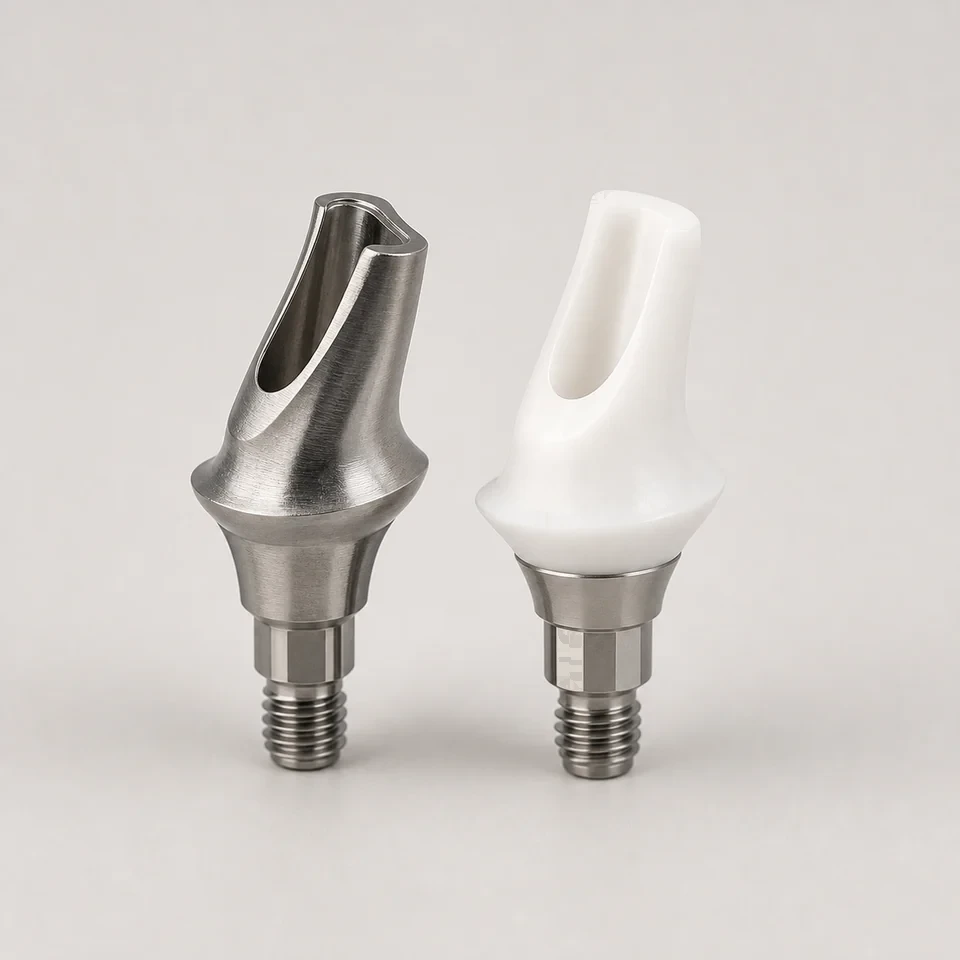
Custom Abutments
Custom abutments designed from scan body data for the confirmed implant system, with emergence profile shaping and retention review.
Details at a Glance
| Restoration type | Implant restoration — abutments for single and multi-unit cases |
|---|---|
| Material options |
|
| Design options |
|
| Commonly considered for |
|
| Records to supply |
|
| Quality focus |
|
| Turnaround | Production time depends on case complexity and confirmed requirements. |
What Custom Abutments Are
A custom abutment dental lab produces patient-specific connectors that shape the transition between a confirmed implant platform and the restoration it supports. Unlike a stock abutment chosen from a limited range, a custom abutment is designed digitally from the case scan so the cuff height, angle and emergence profile follow the individual soft-tissue contour rather than a fixed catalog geometry. KC Dental Lab designs the abutment to seat on the verified implant connection and to carry either a cement-retained crown or, where feasible, a screw-retained crown through an angled or straight channel. The result is a component that supports the final crown while helping the clinician control margin position, cleansability and the gingival form around the tooth. Because the interface is system-specific, the scan body and the digital library must describe the same connection before a design is opened.
Who It Suits
Custom abutments suit clinicians and laboratories managing implant sites where a stock component cannot reach the required margin, angle or tissue height. They are useful when the implant is placed at an angle or depth that a prefabricated abutment does not accommodate, and when the planned crown needs a specific emergence profile for esthetics. The workflow also helps when a single laboratory is coordinating the abutment and crown as one prescription. Typical professional and workflow contexts include:
- Implant clinics restoring anterior sites where the gingival contour is visible in smile and speech.
- Specialist practices managing angled or deep placements that exceed stock ranges.
- Reference laboratories producing the abutment and crown from one digital file set.
- Distributors supporting clinicians who prefer a single coordinated component order.
Indications Commonly Considered
- Sites where stock abutment height or angle does not reach the margin.
- Angulated implants needing a corrected path for the crown.
- Anterior cases where the emergence profile drives esthetics.
- Soft-tissue contours that require a shaped cuff rather than a straight wall.
- Combined abutment-and-crown prescriptions sent as one case.
- Cases where retrievability through a screw channel is preferred.
Material and Design Options
The abutment is selected to match the confirmed interface and the demands of the site. Material and design categories include:
- CAD/CAM titanium custom abutments matched to the system interface.
- Zirconia on a compatible titanium base for selected esthetic zones.
- Angled or straight screw channel designed where the connection allows.
- Prepared or unprepared abutment forms reviewed against the crown plan.
What the Case Needs
The following inputs let the abutment be designed to the individual site:
- Stated implant system, connection and platform for the interface.
- Torque specification and any component or provisional notes.
- Scan body files from the confirmed system library.
- Soft-tissue contour information or a scan of the emergence profile.
- Tissue height, margin position and crown design references.
- Shade, occlusion and any esthetic or phonetic requirements.
Digital Workflow Requirements
A complete digital record supports an accurate emergence-profile design. Expected inputs are:
- Scan body captured with the correct library for the implant system.
- STL, PLY or OBJ export with the soft-tissue contour recorded.
- Opposing arch and bite registration so the crown can be planned.
- Clear margin and insertion-path information for the abutment design.
- Reference photos where the gingival form is part of the plan.
Compatibility to Confirm
These points are reviewed before production so the component seats as designed:
- The exact implant brand, system and platform before design opens.
- That the scan body matches the stated connection and library.
- Whether the crown will be cement-retained or screw-retained.
- The torque and seating details for the final component.
Quality Checkpoints
- Interface and digital library verified against the stated implant system.
- Emergence profile and margin location reviewed against the scan.
- Torque specification and seating checked before the case is dispatched.
- Restorative space, insertion path and crown support confirmed.
- Surface finish, screw access and agreed design details recorded.
- Final inspection of fit and packaging before shipment.
Turnaround Variables
The time to produce a custom abutment depends on the completeness of the implant and soft-tissue records, the choice of titanium or zirconia hybrid construction, and whether the crown is designed together with the abutment. Cases that arrive with a matched scan body, clear tissue height and a defined crown plan move forward more directly, while cases needing emergence-profile clarification or a digital design review take longer. Material finishing and the dispatch route are also part of the schedule, so the realistic window is confirmed per case once the records are reviewed.
Common Questions
How is a custom abutment different from a stock one?
A custom abutment is shaped from the case scan to the individual tissue and margin, whereas a stock part is limited to fixed catalog heights and angles.
Which material should be chosen?
Material depends on the clinical site, esthetic zone, strength needs and confirmed compatibility, with titanium or zirconia-on-titanium considered per case.
Is the scan body enough to begin?
The scan body reference is needed, but the implant brand, system, platform and any component instructions should also be provided before design.
Can the abutment and crown be one order?
Yes, when the crown plan, shade and occlusion are supplied, the abutment and crown can be coordinated as a single prescription.
Next Step
Send the implant compatibility details, tissue information and planned crown design so a custom abutment dental lab review can begin before production. Review our implant restorations and custom abutments pages, then send a case or request a price list when the records are ready.
Related products
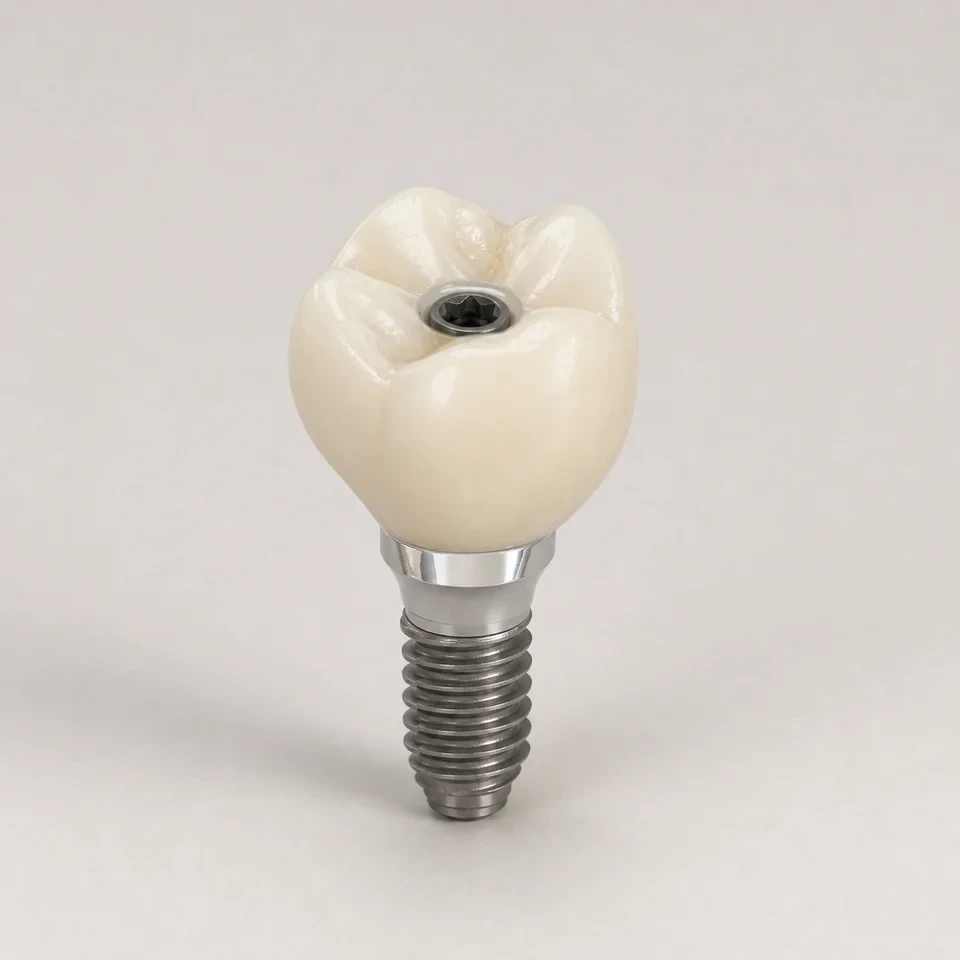
Implant Crowns
Implant-supported crowns designed from scan body data with system and connection verification, retention options reviewed case by case.
View